
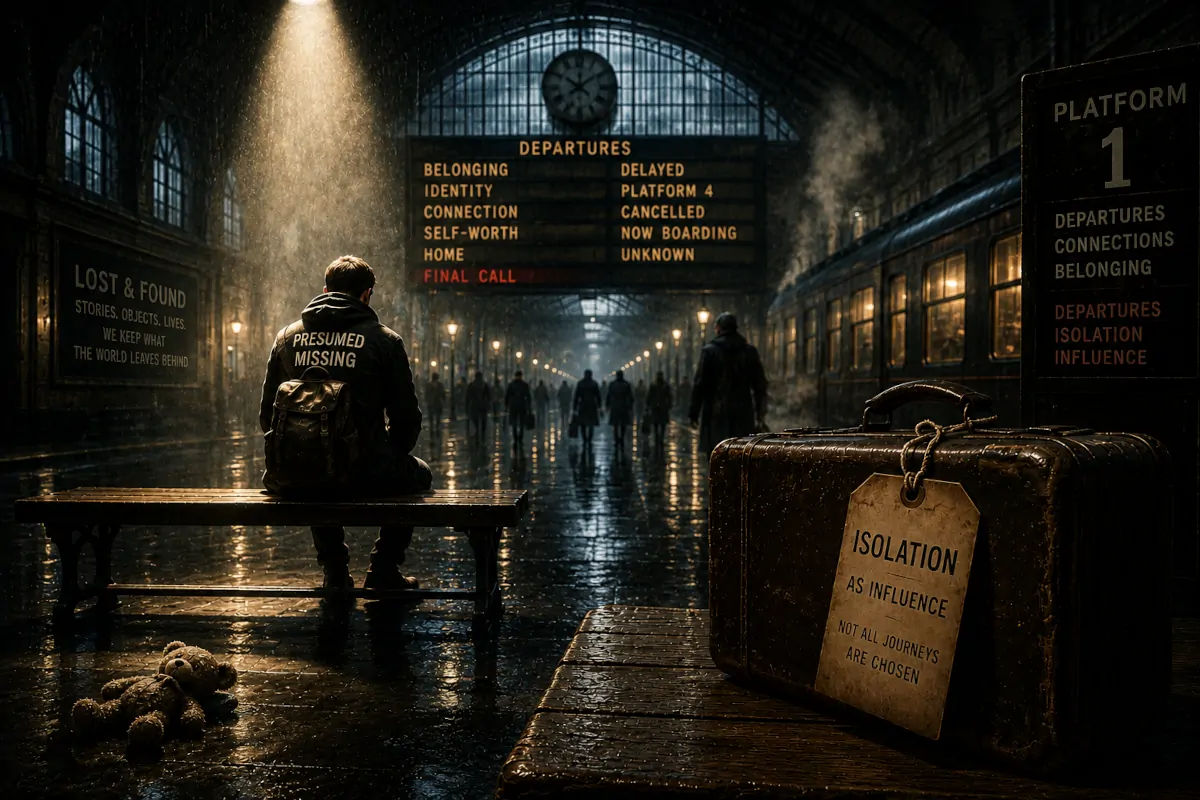
From Isolation to Influence: Notes from the Lost & Found Office
There is something deeply psychological about stations.
Perhaps it is the temporary nature of them. The constant movement. The anonymous urgency.
Departures.
Arrivals.
Reunions.
Delays.
Entire emotional lives unfolding beneath the same artificial light.
Stations are among the few remaining places where modern humanity briefly reveals itself in full.
The ambitious, the displaced, the exhausted, the invisible, the grieving, the hopeful – all pass through the same temporary world carrying far more than luggage.
Some travel lightly.
Others appear burdened by entire emotional histories.
And somewhere within the landscape of motion and noise exists a quieter place often overlooked by the moving crowds:
The Lost & Found Office.
A room filled with abandoned belongings.
Unclaimed suitcases.
Forgotten passports.
Misplaced photographs.
Faded labels.
Objects once considered important enough to carry across countries, cities, relationships and lives – now sitting silently behind counters waiting to be recognised again.
Increasingly, it feels like an accurate metaphor for modern psychological life.
Because many people are no longer simply losing possessions.
They are losing themselves.
The modern world has created millions of emotional commuters – people moving constantly while remaining psychologically stationary.
Never before has humanity travelled so frequently while arriving so rarely within itself.
Modern society excels at accelerating people, yet rarely helps them determine where they are actually going.
In many ways, the station has become a microcosm of modern existence itself.
Overcrowded.
Overstimulated.
Emotionally fatigued.
Filled with people travelling urgently without always knowing why.
Some travellers move with the certainty of individuals carrying destinations within them.
Others wander as though they have misplaced more than directions.
Some people spend years psychologically waiting at platforms they were never meant to remain in.
Others mistake movement for meaning entirely.
They scroll endlessly through the curated destinations of other people’s lives while neglecting the untapped territories of their own.
The virtual world offers the illusion of movement while keeping many emotionally motionless.
Some spend their lives checking in other people’s luggage while never boarding a meaningful journey themselves.
Modern life has created entire populations of psychological baggage handlers – facilitating the dreams, ambitions and emotional journeys of others while remaining spiritually stranded at the terminal gates of possibility.
And perhaps this is one of the great hidden tragedies of our time.
Not that people become lost.
But that so many never truly depart.
The station announcements themselves begin to sound strangely existential when overheard long enough.
Delayed.
Cancelled.
Now boarding.
Mind the gap.
Final call.
Beneath their practical function, they begin to resemble commentaries on human existence itself.
Some opportunities do not disappear dramatically.
They simply move quietly from ‘boarding’ to ‘departed’.
Many people only recognise the significance of a moment after it has already left the platform.
Fear has caused countless individuals to miss emotional trains that may have transformed their lives.
Others remain psychologically seated in the waiting rooms of life for decades – waiting to feel ready, waiting to feel worthy, waiting to feel less afraid.
Existence was never intended to be a waiting room.
Yet modern culture encourages hesitation disguised as preparation.
Some lives are not ruined by catastrophe but by permanent postponement.
These are people who have mistaken safety for living.
People who have become so accustomed to waiting that movement itself now frightens them.
Then there are those who travel in circles.
Circular thinking.
Circular relationships.
Circular self-sabotage.
The same emotional destinations reached through different routes.
Some individuals spend decades psychologically circling the site of their derailment.
A single emotional derailment can alter the direction of an entire life.
Not every interruption is derailment, of course.
Some delays save us from boarding the wrong train.
But certain detours disconnect people from themselves so completely that they no longer remember who originally began the journey.
Many are attempting to navigate modern life using psychological maps drawn decades earlier.
Outdated beliefs.
Inherited fears.
Childhood survival strategies.
Internal traffic programmes they never consciously chose.
Some routes were never theirs to begin with.
Yet they continue following them because familiarity often disguises itself as destiny.
Many people appear emotionally homeless.
Thousands of journeys unfold daily beneath illuminated departure boards, yet genuine human connection remains strangely delayed.
Even in crowded terminals, loneliness remains remarkably efficient.
Nobody lingers in stations anymore.
They scroll through them.
Faces illuminated by screens.
Minds elsewhere.
Bodies present.
Souls delayed in transit.
The digital age has created unprecedented visibility while simultaneously deepening emotional invisibility.
Many people now know intimate details about strangers online while remaining profoundly disconnected from themselves.
Movement is no longer difficult.
Meaning is.
Some people carry invisible luggage packed by other people entirely.
Shame.
Expectation.
Class anxiety.
Trauma.
Rejection.
Unprocessed grief.
Inherited fear.
Modern society teaches people how to carry baggage, but rarely how to unpack it.
Many become so accustomed to emotional weight that they no longer remember what traveling light feels like.
Some give themselves away so completely that very little remains to reclaim.
And perhaps nowhere captures this more painfully than the sight of an abandoned suitcase sitting alone beside a moving crowd.
Once carefully packed.
Once important.
Once belonging somewhere.
Now waiting silently to be collected before eventually being transferred into the Lost & Found Office.
Not every abandoned thing is unwanted.
Some things are simply forgotten in the rush to survive.
The same, perhaps, can be said of human beings.
There are people in this world who have quietly arrived in the psychological Lost & Found long before they ever arrive there physically.
People who misplaced ambition beneath responsibility.
People who lost identity beneath survival.
People who became emotionally stranded somewhere between who they were and who they were expected to become.
And yet not everything lost is gone forever.
Some things simply wait to be recognised again.
Perhaps influence itself begins there.
Not in performance.
Not in status.
Not in visibility.
But in recovery.
In reclaiming the abandoned pieces of oneself left behind at various stations of fear, rejection, distraction or conformity.
The most meaningful journeys are rarely geographical.
They are internal migrations.
The rediscovery of instinct.
Direction.
Authenticity.
Purpose.
The gradual courage required to finally board the life one was meant to inhabit.
At some point, life makes a final call for all of us.
The question is whether we ever truly departed.
Because perhaps the greatest tragedy is not getting lost.
It is remaining forever in transit – carrying unopened versions of ourselves through stations we were never meant to stay in.