
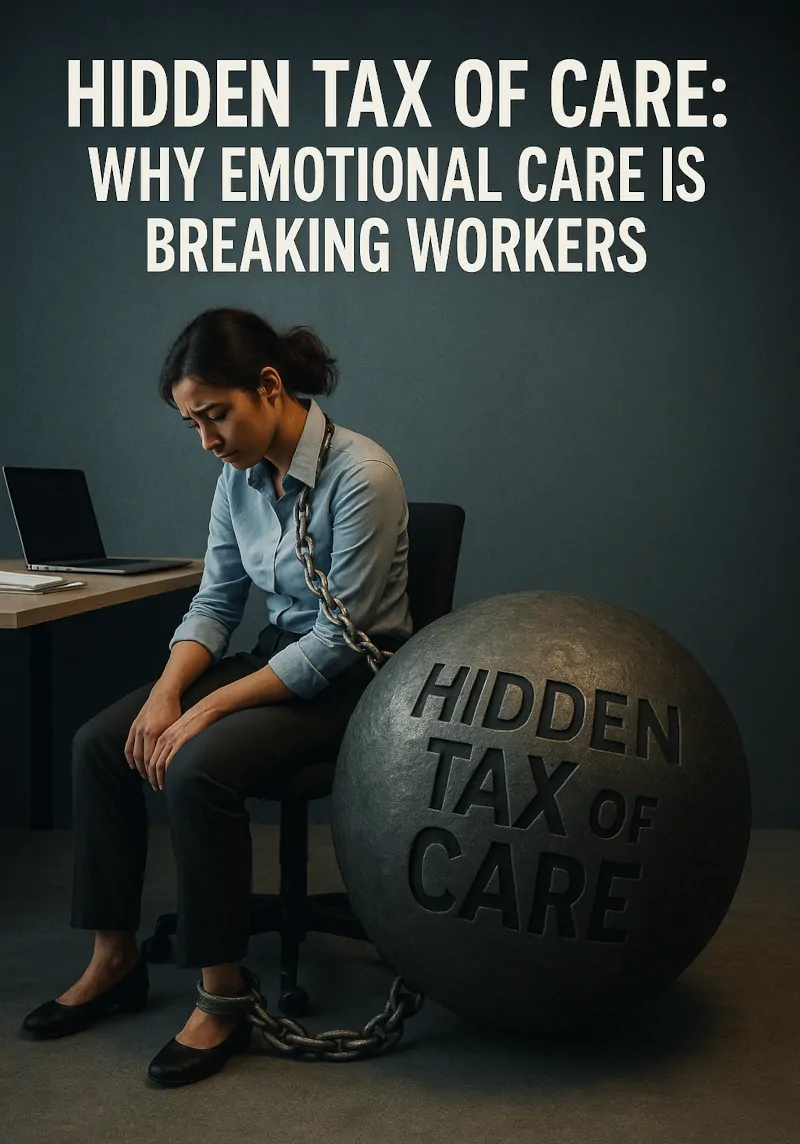
The Hidden Tax of Care: Why Emotional Labour is Breaking Workers
Workplaces run not just on contracts, policies and deadlines – but on something far more invisible: the emotional labour of their people. It’s the unpaid, unmeasured work of calming tempers, smoothing conflicts, mentoring juniors, listening to anxious colleagues, smiling when you don’t feel like it and carrying the quiet burden of everyone else’s unease.
It doesn’t appear on a payslip. It doesn’t count toward promotion. Yet without it, most workplaces would collapse in a week.
And still – it is taken for granted.
The Unpaid Shift Nobody Counts
Official figures already tell us that UK workers gave away around £31 billion worth of unpaid overtime last year. Some 3.8 million people worked an average of 7.2 extra hours every week for free. That is daylight robbery in plain sight.
But beneath those visible numbers is a subtler theft: the emotional “overtime” that nobody records. Every time you play peacemaker, every time you absorb frustration so your boss doesn’t explode, every time you draft the birthday card or on board the nervous new starter – you are subsidising your employer with free psychological energy.
If emotional labour could be metered like electricity, the bills would bankrupt half of Britain’s boardrooms.
A Culture of All Take and No Give
Zero-hour contracts are another quiet cruelty. Today, 1.17 million UK workers live under them, their hours never guaranteed, their livelihoods hanging by a thread. Add to that the policy of unpaid sick days where employees are effectively punished for being human – and the picture is clear: you exist to give and we exist to take.
Work had become a one-way street where loyalty is demanded but rarely returned. The so called “ job for life” has become a myth, replaced by fragile contracts and the looming threat of automation.
This is what dehumanization looks like in slow motion: the reduction of a person to a disposable cog, cheaper to replace than repair.
The Consequences Nobody Wants to Admit
-
Burnout disguised as commitment. The ones who hold everyone else together- often women, often minorities- are celebrated ad “team players” until they quietly collapse.
-
Invisible inequality. Emotional labour is distributed unevenly. Those expected to “keep the peace” lose out on recognition and career progression.
-
A Society addicted to stoicism. We still reward people who drag themselves to work ill and punish those who dare to take rest.
This is not resilience. It is slow death by exploitation.
Robots at the Door
We are told that robots and AI will soon replace human labour – even skilled, white-collar jobs. Perhaps they will. But here is the paradox: as machines take over routine tasks, what remains is the messy, emotional, human part. The part that cannot be automated.
And if we continue to treat emotional labour as free, infinite and invisible, then the last thing left of work will also be the most exploited.
Is It Even Worth Working for Others?
A brutal question but an honest one. If work means endless giving with no reciprocity, if it means carrying the emotional burdens of others without recognition, then perhaps the real myth is not the job for life but the myth of work itself as a fair exchange.
Work can be dignified. It can be a place of growth, community and creation. But only if we acknowledge that care is labour.
A New Social Contract
Here is what should be non-negotiable:
-
Name it. Pay it. Share it. Emotional labour must be recognised as real work. If it sustains culture, it should be valued like strategy or sales.
-
End the silent tax. Stop expecting staff to carry the emotional weight of under- resourcing and poor policies.
-
Protect humanity in the age of machines. If robots are coming, then let humans do what only humans can do and let them be rewarded fairly for it.
Workplaces love to talk about innovation. But the real innovation is honesty. To finally admit what has always been true: that the hidden engine of work is not just skill or time, but heart.
And the heart, unlike a machine, is not replaceable.
“ Care is work. Pay it. Protect it. Or watch the culture you depend on quietly fall apart.”