
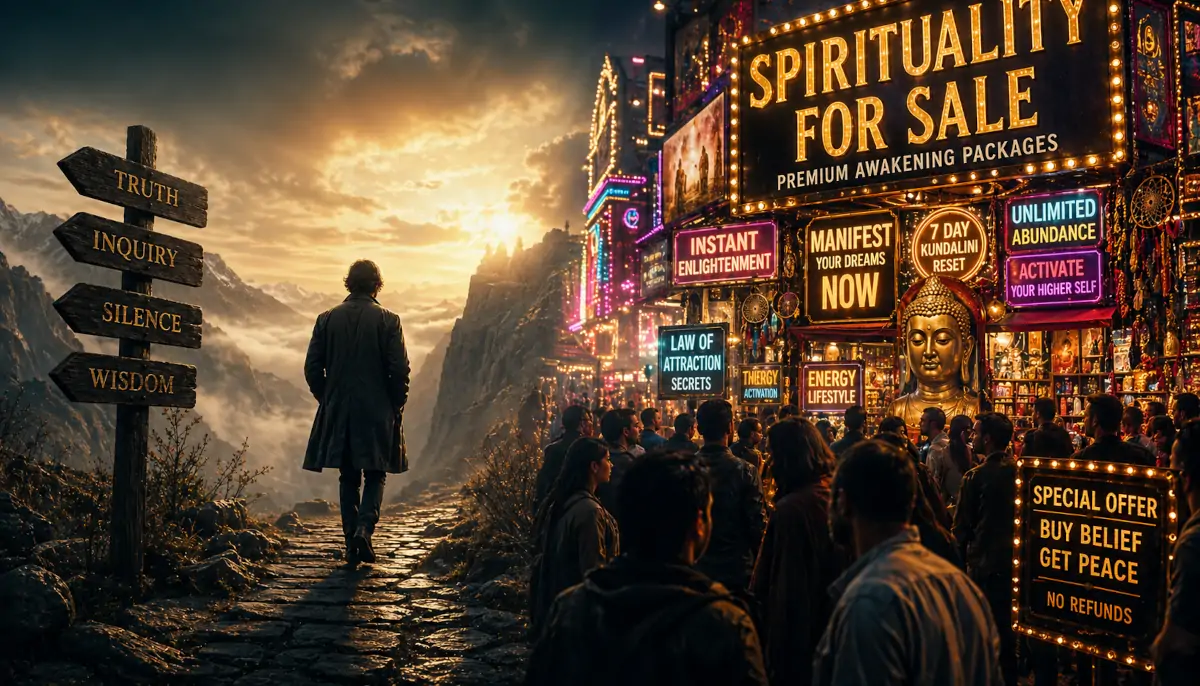
When Mysticism Becomes Merchandise: Why Intellectuals Walk Away
As spirituality becomes more visible, it risks becoming less understood.
Something strange is happening in modern spirituality.
The more visible it becomes, the less serious it is taken.
Walk into a contemporary esoteric exhibition and you’ll find crystals, tarot, ancestral symbols – all beautifully displayed, carefully branded and instantly available.
But look closer and you’ll notice something else.
The people who have spent years studying these traditions are nowhere to be seen.
This isn’t just about mysticism.
It reflects a wider cultural pattern – where depth is increasingly replaced by immediacy and meaning is condensed into something we can consume quickly, without having to fully understand it.
In many ways, the modern spiritual marketplace mirrors the way we now approach everything: identity, purpose, even healing.
Mysticism, by its nature, resists simplification.
It is layered, symbolic, paradoxical. It demands patience, study and a willingness to sit with uncertainty.
Historically, it was never designed for mass consumption – not because it was elitist but because it required initiation, not just interest.
Today, however, mysticism is increasingly repackaged into something quicker, cleaner and more commercially viable.
What was once a journey becomes a transaction.
There is nothing inherently wrong with accessibility.
But when accessibility comes at the cost of accuracy we are no longer opening doors – we are redesigning the room entirely.
The academic and critically-minded observer is not opposed to accessibility.
What they resist is distortion.
When esoteric systems are presented without their intellectual scaffolding, they risk becoming aesthetic rather than meaningful.
To the trained eye, this creates a kind of cognitive dissonance.
Depth is implied but not delivered.
Authority is suggested but not earned.
Mystery is performed rather than explored.
It is not cynicism that drives intellectuals away. It is discernment.
The question is no longer whether mysticism should be accessible.
The question is whether we, as participants in this culture, are willing to go deeper than what is immediately presented to us.
The future of mysticism will not be decided by academics or exhibitors alone.
It will be shaped by those who refuse to choose depth and accessibility – and instead insist on both.