
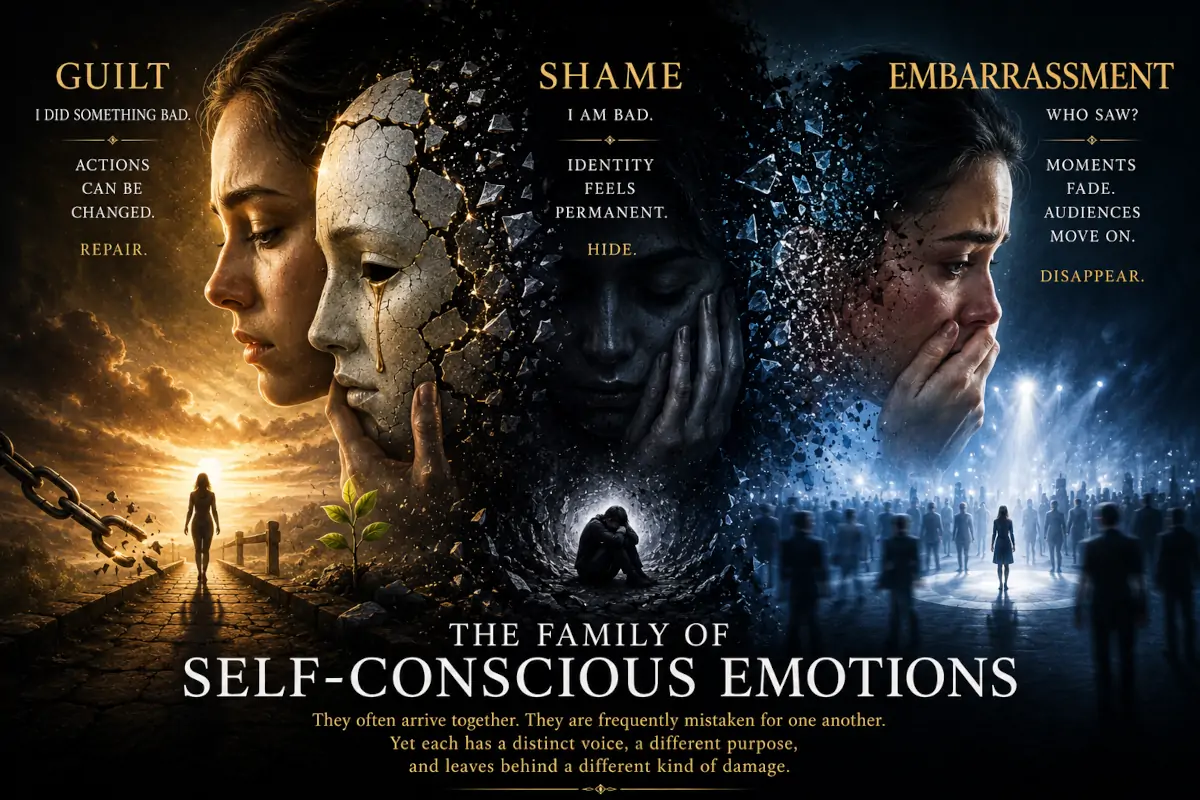
The Family of Self-Conscious Emotions
“They often arrive together. They are frequently mistaken for one another. Yet each has a distinct voice, a different purpose and leaves behind a different kind of damage.”
Stop for a moment.
Before you read another sentence, think of something you wish you hadn’t said.
Not something criminal.
Not something cruel.
Just…unfortunate.
You remembered something, didn’t you?
Interesting.
Your mind has just retrieved a moment that may have happened 10, 20 or even 40 years ago without any effort at all.
It was waiting.
Why?
Why do some memories quietly disappear while others refuse to loosen their grip?
A forgotten name.
An awkward joke.
Walking confidently into the wrong room.
Waving enthusiastically at someone who wasn’t waving at you.
Calling your teacher “Mum.”
Introducing somebody twice
Nobody else remembers.
Yet your body behaves as though it happened yesterday.
Your breathing changes.
Your stomach tightens.
You almost feel your face warming again.
Memory isn’t replaying the event.
It’s replaying the meaning.
Emotion edits memory.
Human beings have an extraordinary habit.
We mistake memories for evidence.
Evidence of what?
Evidence of who we think we are.
Every uncomfortable memory quietly asks the same question:
What does this say about me?
Not…What happened?
What happened is over.
Meaning remains.
Most of the moments that haunt us would be impossible for anyone else to remember.
Yet we continue carrying them like evidence against ourselves.
There are three emotions particularly skilled at collecting this evidence.
They work together.
Borrow each other’s clothes.
Occasionally disguise themselves as one another:
Most people think they are interchangeable.
They aren’t.
I think of them as…
The Family of Self-Conscious Emotions.
Guilt.
Shame
Embarrassment.
Every family shares a surname.
That doesn’t mean they share the same personality.
Confuse these three and you may misunderstand yourself for the rest of your life.
Which hurts more?
Doing something wrong?
Being seen doing something wrong?
Or believing that what happened says more about who you are?
If your answers changed, you’ve already met the family.
Guilt says:
“I shouldn’t have done that.”
Points towards behaviour.
Towards something that can still be repaired.
Shame changes one word.
“I did something bad.”
becomes
“ I am bad.”
One missing word.
An entirely different life.
Behaviour can change.
Identity feels permanent.
People apologise because of guilt.
Disappear because of shame.
Human beings rarely respond to events.
They respond to the meaning they attach to events.
Embarrassment asks a different question.
Who saw?
Nothing changed.
Except the audience.
We are starring in a film that almost nobody else is watching.
Families resemble one another.
That does not make them identical.
Picture a child spilling a glass of milk.
‘Let’s clean it up.’
Problems can be solved.
‘Look what you’ve done.’
Mistakes disappoint people.
‘Why are you always like this?’
The child stops thinking about milk.
They start thinking about themselves.
The milk is identical.
The lesson is not.
Children remember the meaning attached to events.
Which sentence from childhood are you still trying to prove wrong?
People rarely argue about events.
They argue about what those events mean.
The next time someone says,
‘I feel terrible.’
Don’t finish the sentence for them.
Are they grieving something they did?
Listen.
Something they believe they are?
Or simply a moment they wish nobody else had witnessed?
Those are three entirely different conversations.
As I’ve grown older I’ve become less interested in asking:
‘What happened?’
The more revealing question is:
‘What did it come to mean?’
Behaviour begins there.
Not with events.
With meaning.
Perhaps guilt doesn’t need condemning.
Perhaps embarrassment doesn’t deserve remembering.
Perhaps shame has been telling lies for much longer than we realised.
Although they belong to the same family, they have never spoken the same language.
The next time one of them knocks on your door…
Pause before answering.
Make sure you know which one you’re inviting in.
About the Author
Pia Madison FRSA is the Founder of Psychologistics. Her essays explore the hidden psychology of everyday life – how meaning is created, how behaviour is shaped and why the conversations we have with ourselves often matter more than the events that first inspired them.
Exploring the psychology beneath everyday life.