
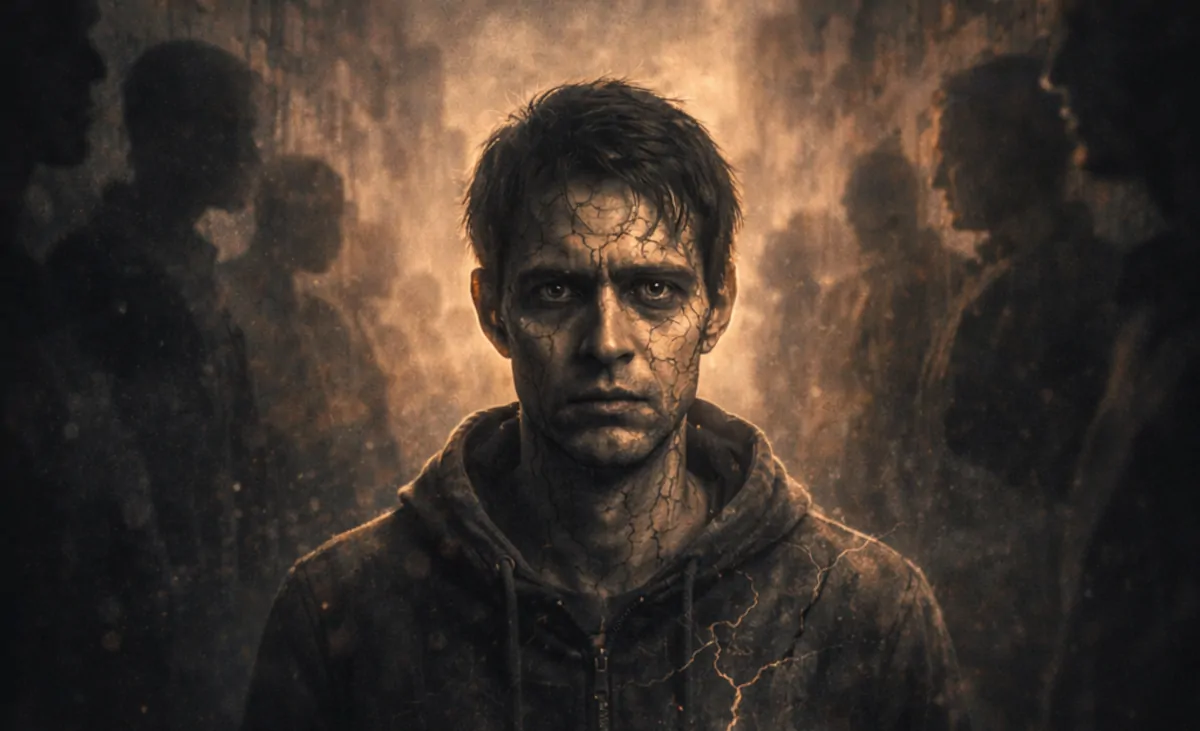
Reclaiming Madness: Notes from the Edge of Meaning
“An abnormal reaction to an abnormal situation is normal behaviour.” – Viktor Frankl
We are living in an era that diagnoses faster than it understands. Language has multiplied – trauma, anxiety, burnout, deregulation- yet the inner life of human beings feels increasingly unconstrained, unnamed, and, in many cases, unheard.
We have not become more fragile. We have become more exposed.
Madness, once feared as rupture, now sits in the centre of the cultural room. It moves through our institutions, our relationships, our screens and our private lives. It appears in the exhausted worker, the alienated adolescent, the dissociate survivor, the artist unable to translate what they see into something bearable.
And still, we ask the wrong question.
Not what is wrong with them? But what is happening to us?
To reclaim madness is not to romanticize suffering, nor to dismiss the reality of psychological collapse. It is to recognise that what we call madness may, at times, be the psyche’s last refusal to conform to a world it cannot metabolise.
Madness is not always a malfunction. Sometimes, it is a signal flare.
The Breaking Point of Normality
“ Normal “ has become one of the most dangerous words in modern psychological language. It implies stability, coherence, predictability – a baseline against which deviation can be measured and corrected.
But normality is not neutral. It is constructed.
It is shaped by economic demand, cultural expectation, technological acceleration and social conditioning. It rewards productivity over presence, compliance over inquiry, adaptation over authenticity.
To function seamlessly in such a world is often praised as health.
Yet the psyche knows when something is amiss.
Breakdown is not always failure. Sometimes it is the psyche refusing to continue a performance it can no longer sustain.
Meaning collapses first. Symptoms arrive later.
And what we call madness may, in fact, be the moment the internal architecture gives way under the weight of an unlivable reality.
Madness as Language
Long before it becomes clinical, madness is expressive.
It speaks through the body – through panic, numbness, insomnia, fragmentation. It speaks through image – dreams, symbols, intrusive memories, altered perception. It speaks through rupture – sudden withdrawal, erratic behaviour, states of overwhelm.
We tend to interpret these as malfunctions.
But what if they are communications?
Across cultures and histories, altered states were not always treated as pathology. They were understood as thresholds- imitations, crisis of identity and encounters with the unseen dimensions of existence.
The modern world, in its pursuit of rational order, stripped these experiences of context. What remained was the symptom without the story.
But human beings are narrative creatures.
When meaning is removed, distress intensifies.
Reclaiming madness is, in part restoring the story to the symptom.
Trauma: The Invisible Architecture
Trauma reorganises perception. It alters the nervous system, memory, identity and expectation. It reshapes what feels safe, what feels possible and what feels real.
Yet trauma rarely exists in isolation.
It accumulates – across families, across communities, across generations. It embeds itself in structures: poverty, marginalisation, violence, displacement and invisibility.
The individual who collapses often carrie’s more than their own story.
Madness, in this sense, becomes relational.
A response not only to personal experience, but to environments that overwhelm the psyche’s capacity to integrate.
The so-called “symptom” may be the only truthful response available.
The Sensitivity Problem
There exists a category of individuals who feel too much, see too much, think too deeply for the tempo of the world they inhabit. Their sensitivity is not weakness; it is permeability.
They register contradiction. They detect dissonance. They sense what others suppress.
Historically, such individuals have become artists, healers, philosophers, mystics – and, at times, psychiatric patients.
The line between insight and instability is not fixed. It is contextual.
In environments that honour depth, sensitivity becomes intelligence. In environments that demand conformity, it becomes liability.
Madness may emerge where perception exceeds containment.
The Politics of Psychological Pain
Who gets to be “mad”? Who gets to be treated? Who gets to be punished?
Distress is not distributed equally.
Some are medicated. Some are institutionalised. Some are criminalised. Some are ignored. And some – often those with social power – are called “eccentric,” “brilliant,” or “ complex.”
To reclaim madness is to interrogate the structures that define it.
Because what we name as pathology is often entangled with power, class, race, gender and access.
Madness can be collapse. Madness can be protest. Madness can be refusal. And sometimes, it is all three.
Where Psychology Meets the Sacred
There are moments in psychological life that do not fit neatly into clinical language. States of dissolution, encounters with meaning so vast they destabilise identity. Experiences that feel, simultaneously, terrifying and luminous.
Modern psychology often approaches these as symptoms to be stabilised. Yet for many, they feel like thresholds.
“ The psychotic drowns in the same waters in which the mystic swims with delight.” – Carl Jung
Jung’s observation is not romanticisation. It is a warning.
The terrain is the same. The outcome depends on containment.
Without support, these experiences fracture the self. With guidance they can reorganise it.
Madness and awakening may occupy neighbouring territories. The difference lies in whether one journeys alone.
Witnessing: The Antidote to Exile
The deepest wound carried by many in distress is not their suffering – it is their exile.
To be labelled, dismissed, or reduced to a diagnosis is to be removed from relational reality. Healing begins not with intervention, but with witnessing.
To be seen without correction. To be heard without Interpretation. To be held without urgency.
Witnessing does not resolve madness. It restores humanity.
Integration and the Aftermath of Collapse
There is a life after psychological disintegration, though it is rarely spoken of.
Those who have traversed madness often return altered – not repaired in the mechanical sense, but reorganised.
Madness becomes not merely an episode but a passage – a movement from unexamined existence into conscious relation with reality.
A Culture Near Its Threshold
We must resist the temptation to treat rising psychological distress as an individual epidemic. It is cultural.
We live within accelerating systems that fragment attention, erode community and destabilise identity.
Perhaps madness is increasing because the structures surrounding us are unsustainable.
The Language We Choose
To reclaim madness is to reclaim language – language that allows for complexity: psychological, social, existential and spiritual.
Madness can be a wound, a protest, a message, a transformation, a rupture in the known world that forces a confrontation with truth.
Conclusion: The Courage to Listen
Madness destabilise certainty. It dissolves identity. It interrupts continuity. To reclaim madness is to remain in the presence of what we do not yet know how to name. Perhaps the most radical act available to us now is not silence madness, but to listen to it. Because within its fracture may lie the very insights required to make a fractured world livable again.